🎧 Listen to this article
In short: A full moon ritual is a symbolic personal practice held during or near the full moon to mark a moment of intentional release and gratitude. For November 2026, the Beaver Moon reaches its peak on November 24 at 14:53 UTC, making the evenings of November 23 and 24 ideal for a quiet, reflective ceremony.
—
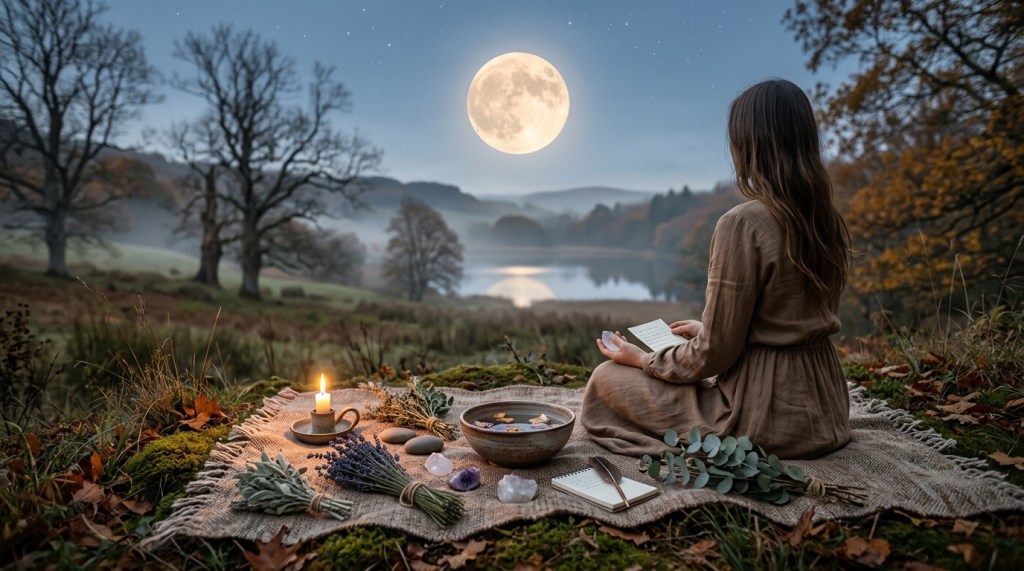
It is half past eight on a November evening. You have set a single candle on the table, opened a window just slightly, and now you are sitting still, notebook in hand.
What you feel is not superstition: it is the ancient human impulse to mark time with intention.
In brief:
- A full moon ritual works as a symbolic anchor, not a guaranteed energy event.
- The November 2026 Beaver Moon peaks on November 24 at 14:53 UTC.
- Release and gratitude are the two pillars that make this practice quietly powerful.
What Is a Full Moon Ritual, and Why Do People Practice It?
A full moon ritual is a deliberate pause — a set of symbolic gestures performed around the time of the full moon to bring awareness to what you are ready to let go of and what you wish to honor in your life. It is not a magical formula. It is closer to a ceremony of honest reflection, the kind that any thoughtful person might need at the end of a long month.
The tradition of gathering meaning around the lunar cycle is found across Indigenous North American, Celtic, East Asian, and Hindu cultures, among many others. What they share is not a belief in supernatural lunar power, but a recognition that the visible fullness of the moon makes an effective psychological anchor for inner work.
To be clear: no peer-reviewed research currently establishes that the full moon produces measurable psychological transformation or a specific energetic field. What is well-documented is that ritual itself — the deliberate, repeated act of marking meaningful moments — supports reflection, emotional processing, and a sense of continuity in one’s inner life.
The November 2026 Beaver Moon: Timing and Context
The November full moon carries the traditional Algonquin name « Beaver Moon, » a name recorded in colonial-era almanacs that referenced the season when beaver traps were set before winter ice. In 2026, this moon reaches its precise maximum on November 24 at 14:53 UTC — mid-afternoon in Greenwich, morning in the Americas.
For an evening practice, the nights of November 23 and 24 are both excellent. The moon will appear visually full to the eye on both nights, rising in the east as the sun sets in the west. You do not need to wait for the exact UTC moment. The symbolic work is not diminished by a few hours’ difference.
Does the Phase of the Moon Actually Matter for a Ritual?
The phase matters symbolically, not physically. Choosing the full moon as your ritual anchor is a way of aligning your personal calendar with a visible, shared natural event. This shared quality — the fact that countless other people around the world are pausing under the same moon — can itself add weight and meaning to your private practice.
Preparing a Simple Space for Your Practice
You do not need a special altar, crystals, or any purchased materials. What you need is a quiet corner, fifteen to thirty minutes without interruption, and two clean sheets of paper.
Consider placing one object that feels meaningful to you — a stone from a walk, a photograph, a small plant. Its role is simply to signal to your nervous system that this time is different from the rest of your evening. That signal is enough.
Dim the lighting if possible. If you can sit near a window where the moonlight is visible, that is a natural addition. If not, a single candle or a lamp turned low serves the same purpose.
What Should You Write During a Full Moon Ritual?
You write in two movements, kept on separate pages or in separate sections of your notebook.
First movement — release: Write, without editing yourself, everything you are genuinely ready to stop carrying. This may include a habit, a resentment, a story you have been telling about yourself, a fear that has outgrown its usefulness. Keep the language concrete. « I am ready to release the belief that I must earn rest » is more useful than a vague general statement.
Second movement — gratitude: Write what you can honestly say you are grateful for this month. Aim for specificity over abundance. Three precise, felt observations carry more weight than a list of twenty items written quickly. « The conversation with my sister on the fourteenth of November » names something real. It lands differently than « my family. »
The Practice of Symbolic Release
Once you have written your release page, you have several options for what to do with it. Many people fold it and place it in a fireproof bowl, then burn it safely — the act of watching the paper become ash is a clean, visceral way to complete the gesture of letting go. Others simply tear the page into small pieces and discard them intentionally.
Neither approach changes the material reality of your life in that moment. What changes is your relationship to what was written. The symbolic act of release creates a before and after in your experience of the thing you named.
If burning is not safe or practical in your space, writing the release page and then placing it in a drawer you will not open for thirty days works just as well. The key is the deliberate physical gesture of separation.
Closing the Ritual with Presence
After both writing movements and your chosen release gesture, sit quietly for three to five minutes without doing anything. No phone, no music, no next task. This is not meditation in any formal sense — it is simply the act of letting what you just did settle into the body.
You may notice a lightness, or you may notice nothing in particular. Both are valid. The ritual is complete whether or not a specific feeling arrives. The value was in the attention you brought, not in a result you must now assess.
If you wish, close by speaking one sentence aloud — something that feels like a quiet declaration for the coming weeks. Keep it simple and in your own voice.
Sustaining the Practice Beyond One Evening
A single full moon ritual is meaningful. A practice held over several lunar cycles becomes something more: a personal record of what has shifted in you over time. Many practitioners keep a brief note after each ritual — not a journal entry, but a single line that captures the essence of what they named and released.
In twelve months, those twelve lines become a quiet map of an interior life. That map has nothing to do with lunar energy and everything to do with the discipline of honest, recurring self-reflection.
The November 2026 Beaver Moon is simply a good evening to begin, or to begin again.
Key Takeaways
- A full moon ritual is a symbolic practice of intentional release and gratitude, not a demonstration of measurable lunar energy effects.
- The November 2026 Beaver Moon reaches its peak on November 24, 2026, at 14:53 UTC; the evenings of November 23 and 24 are both suitable for a practice.
- The ritual requires no special materials: a quiet space, two sheets of paper, and fifteen to thirty uninterrupted minutes are sufficient.
- Writing a release statement in concrete, specific language is more effective than vague general intentions.
- Gratitude writing gains depth through specificity — three precise observations carry more weight than a long, quickly assembled list.
- Maintaining a brief record after each lunar ritual over several months creates a personal map of inner change that compounds meaningfully over time.
FAQ
What is a full moon ritual?
A full moon ritual is a deliberate symbolic practice performed around the time of the full moon to invite intentional reflection, release, and gratitude. It typically involves quiet writing, a simple gesture of letting go, and a few minutes of stillness. No special materials or spiritual beliefs are required — the practice works through the discipline of focused attention.
When is the November 2026 full moon, and what is the best time to do a ritual?
The November 2026 Beaver Moon reaches its precise peak on November 24 at 14:53 UTC. For an evening practice, the nights of November 23 and 24 are both ideal, as the moon appears visually full to the eye on both dates. You do not need to observe the exact UTC moment for your ritual to be meaningful.
Does a full moon ritual actually work?
A full moon ritual works as a structured prompt for self-reflection, not as a conduit for supernatural energy. No reliable research establishes that the full moon causes measurable psychological transformation. What is well-supported is that intentional, recurring ritual practice helps people process emotions, clarify intentions, and maintain a sense of inner continuity over time.
What should I write during a full moon ritual?
During a full moon ritual, write in two distinct movements: first, name what you are genuinely ready to release, using concrete and specific language; second, record a small number of precise, felt gratitudes from the past month. Specificity in both sections increases the emotional and reflective value of the practice.
Can I do a full moon ritual indoors without any special tools?
Yes. A full moon ritual requires only a quiet space, a notebook, a pen, and fifteen to thirty minutes without interruption. A candle or dimmed light can help signal to your nervous system that this time is intentional, but no crystals, altar items, or purchased materials are necessary. The practice is defined by attention, not by objects.
How often should I practice a full moon ritual?
A full moon ritual is naturally suited to a monthly rhythm, aligned with each lunar cycle. Practicing consistently over three to six months allows you to track genuine interior shifts through brief notes kept after each session. Even one or two annual observances — such as the November Beaver Moon — can serve as meaningful anchors if a monthly practice is not sustainable.
Read also
- Returning to Your Practice Journal After Weeks of Silence: How to Reopen the Pages Without Judgment or Forced Continuity
- Keeping a Spiritual Practice Journal: Learning to Distinguish Raw Observation from Personal Interpretation
- Responding Quickly to a Minor Emergency Without Scattering: What Practice Refines When Speed Is Suddenly Required
✨ Want to go further? Discover Université
medecinespirituelle.com

